
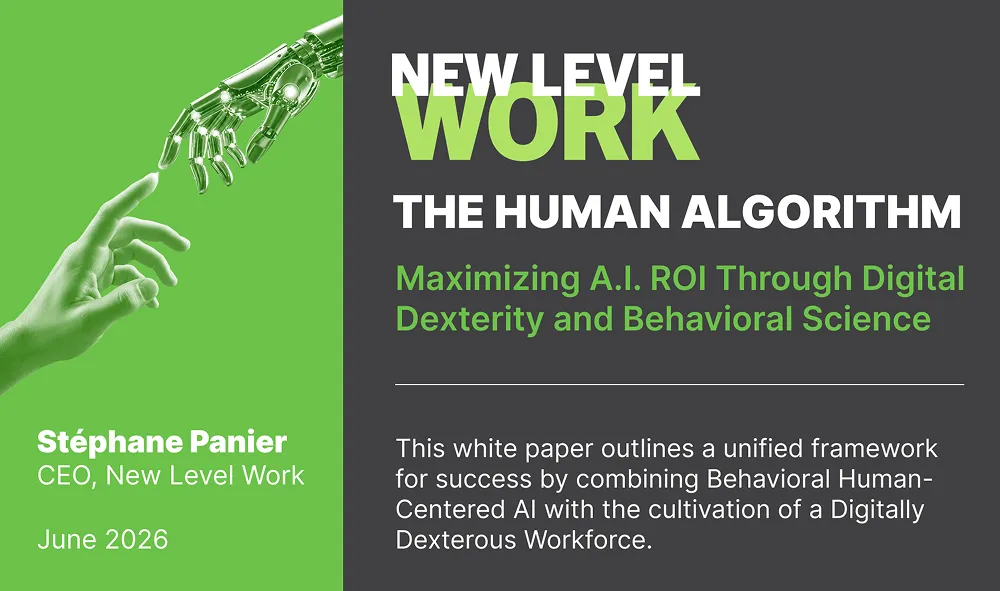
The Human Algorithm
Maximizing AI ROI Through Digital Dexterity and Behavioral Science

Your AI problem is not an AI problem
Algorithmic Aversion
Employees fixate on a single AI mistake and abandon the tool entirely — even when it statistically outperforms human judgment over time. One visible error erases months of goodwill.
Illusion of Understanding
Workers overestimate how well they grasp their own decision-making, then dismiss AI as a black box by comparison. The irony: the human mind is the more opaque system — it just gets the benefit of the doubt.
Loss Aversion
When workers perceive AI as threatening their routines, status, or job security, they actively route around it — reverting to spreadsheets and manual processes despite mandate from above.
The Cultural Chasm
Traditional organizations are attempting to run advanced AI ecosystems on legacy corporate cultures. The single biggest difference between them and a tech company? Their relationship to failure.
"The future of business belongs to leaders who understand that the ultimate key to digital transformation is not the technology itself, but the digital dexterity, emotional intelligence, and adventurous spirit of the humans who wield it."
What you'll learn
A 23-page research-backed framework for closing the gap between AI investment and AI return — written by a CEO who has spent 25 years at the intersection of leadership and organizational change.
The Transformation Paradox
Why well-funded, technologically sound AI projects keep failing — and the behavioral science that explains it.
The Cultural Chasm
Every company is now a tech company. What that really means — and why most organizations are not culturally ready for it.
The Digitally Dexterous Workforce
The 5 critical cultural characteristics that define organizations succeeding at AI adoption right now.
A Behavioral Human-Centered AI Framework
A 3-phase execution model built on behavioral science — not IT project management — to embed AI that actually sticks.
The Human Catalyst
Why leadership coaching — not software training — is the highest-leverage intervention for accelerating AI ROI.
5 Coaching Focuses for the AI Era
Specific, actionable coaching interventions: from psychological safety to the "Bridger" capability and beyond.
A few things that will challenge your assumptions
Here's a preview of the thinking inside. The full framework, evidence, and playbook are in the paper.
AI resistance is a feature of human psychology, not a bug in your change management plan
Loss aversion, algorithmic aversion, and the illusion of understanding are hardwired cognitive biases. Employees don't adopt AI when it objectively improves their work — they adopt it when they feel psychologically safe to experiment and fail.
The biggest difference between a legacy enterprise and a tech company is their relationship to failure
Tech cultures treat failure as data. Traditional corporate cultures treat it as a career-limiting event. Working with AI is inherently iterative — it cannot thrive where perfection on the first try is the expectation.
Shifting from "data-driven" to "data-informed" language measurably reduces employee resistance
The framing of how data and AI tools are positioned to employees has a direct impact on adoption rates. Small shifts in corporate rhetoric unlock meaningful behavioral change — without a single line of new code.
When every company has the same AI, leadership becomes the only differentiator left
As generative AI models commoditize, the organizations that win won't be those with the best technology. They'll be those with the most digitally dexterous leaders — and the coaching infrastructure to develop them at scale.
A Behavioral Human-Centered
AI Framework

Designing for cognitive shortcuts — intentionally adding a little friction so users scrutinize AI output more closely, improving error-correction rates
Combating inventor's bias — co-creating tools with diverse groups of end-users through rigorous beta testing
Rooting out algorithmic biases, validating hypotheses quickly, and giving employees a sense of ownership

Framing AI as an augmenter — a tool that handles repetitive tasks and frees employees for higher-value, innovative work
Making mistakes relatable — positioning AI as a "learning partner" rather than an infallible authority, normalizing trial-and-error
Providing transparency — using explainable AI and proactively disclosing limitations, biases, and safeguards to increase trust

Measuring what matters — behavioral KPIs beyond standard IT metrics: employee trust, perceived fairness, and genuine adoption rates
Avoiding the escalation of commitment — adopting the tech industry's "fail fast" mindset, willing to course-correct or pull the plug quickly
About the Author
Stéphane Panier is the CEO of New Level Work, a global leadership development company serving 300+ enterprise clients including Johnson & Johnson, NASA, Dropbox, and DraftKings.
With 25+ years at the intersection of organizational psychology, behavioral science, and executive leadership, Stéphane has spent his career studying why people adopt — or resist — change at work. The Human Algorithm is his framework for what organizations must do differently to finally realize the promise of AI.
Your AI ROI problem is a leadership problem.
Get the full white paper — free. No fluff, no paywalls. Just a practical playbook for the leaders building the future of work.
Discover the New Level Work Difference
Our carefully-vetted and developed community of certified coaches and trainers bring business savvy and real-world management experience to help drive the business outcomes you seek. Demonstrated by our 5 star ratings and 90+ NPS score, our customers agree.

Worldwide
Footprint

90+ NPS
Score

Real World
Experience

Satisfaction
Guaranteed
Your AI ROI problem is a leadership problem.
Get the full white paper — free. No fluff, no paywalls. Just a research-backed playbook for the leaders building the future of work.